


I Ching Yarrow Stalks: How to Cast a Reading with Yarrow
Casting with yarrow stalks means setting aside 1 of 50 stalks and dividing and counting the other 49 three times for each of six lines. The totals 6, 7, 8 or 9 give each line, and the odds of changing lines differ from the three-coin method.
To cast the I Ching with yarrow stalks, you set aside 1 of 50 stalks, then divide and count the other 49 in fours three times to get one line. The three counts always add up to 6, 7, 8 or 9, which tells you whether the line is yin or yang and whether it's changing. Six lines, built from the bottom up, make your hexagram: 18 rounds of counting in all.
What do I need before I start?
- 50 stalks. Dried yarrow (Achillea millefolium) is traditional. Thin wooden sticks of the same length work just as well, because the method depends on counting, not the plant.
- A clear table for making heaps.
- Paper and a pen. Write each line's number down as soon as you get it.
- Your question, written down, so it stays the same through all six lines.
- Unhurried time. Eighteen rounds take a while, and the slowness is much of the appeal.
How do I get one line?
The steps follow the method described in Richard Wilhelm's The I Ching or Book of Changes, translated into English by Cary F. Baynes. The 49 comes from the book's own Great Appendix: of the 50 stalks, "(only) 49 are used," in James Legge's translation, The I Ching (Sacred Books of the East, 1882).
First round
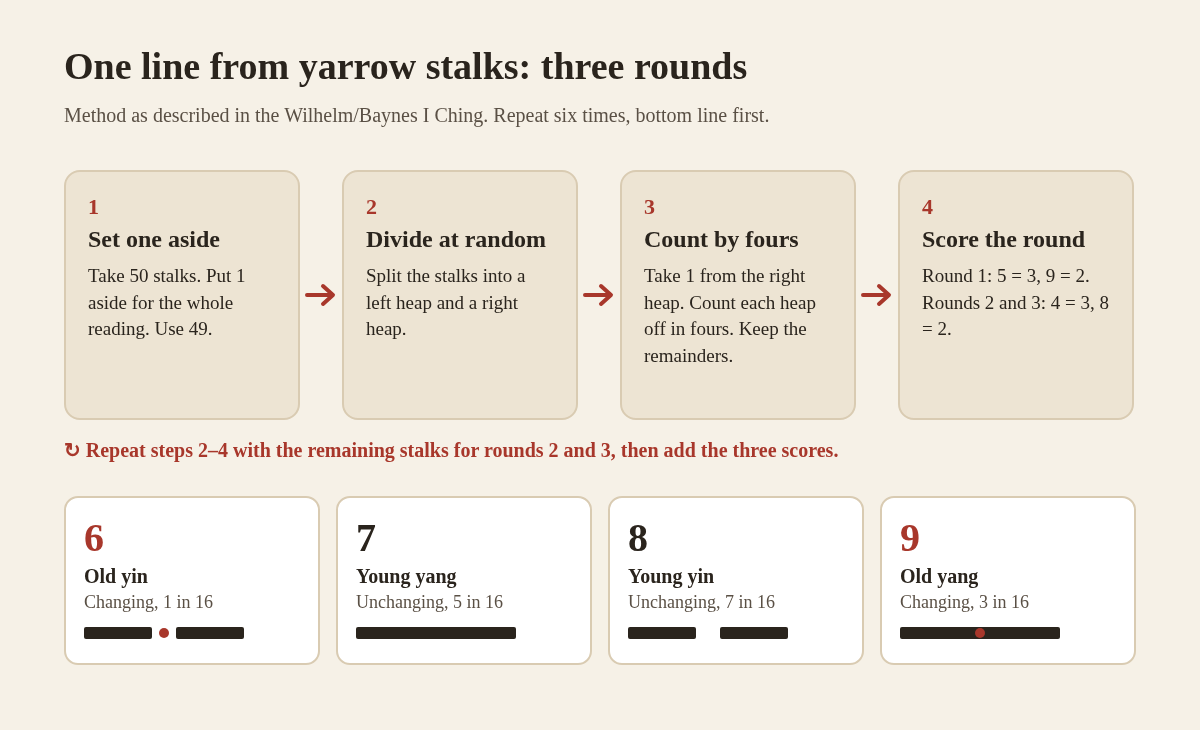
- Put 1 stalk aside. It stays out for the whole reading.
- Split the 49 at random into a left heap and a right heap.
- Take 1 stalk from the right heap and hold it between the little and ring fingers of your left hand.
- Count the left heap off in fours until 1 to 4 remain. Hold the remainder between your ring and middle fingers.
- Do the same with the right heap and hold that remainder between your middle and index fingers.
- Count what's in your hand. It will be 9 or 5. Put those stalks aside. 5 scores 3; 9 scores 2.
Second and third rounds
- Gather the stalks still on the table and repeat steps 2 to 5.
- This time your hand holds 8 or 4. 4 scores 3; 8 scores 2. Put them aside.
- Repeat once more with what's left, scoring the same way.
Add the three scores
| Total | Line | Changing? |
|---|---|---|
| 6 | Yin (broken) | Yes, old yin becomes yang |
| 7 | Yang (solid) | No |
| 8 | Yin (broken) | No |
| 9 | Yang (solid) | Yes, old yang becomes yin |
That's your bottom line. Gather all 49 stalks and repeat for lines two to six. If a round ever gives a hand count other than the ones above, a count slipped; redo that round.
Do yarrow stalks and coins give the same results?
They give yin and yang equally often, but not the same changing lines. With yarrow, an old yang line (9) is three times as likely as an old yin line (6). With three coins, the two are equally likely.
| Line | Yarrow stalks | Three coins |
|---|---|---|
| 6, old yin (changing) | 1 in 16 | 2 in 16 |
| 7, young yang | 5 in 16 | 6 in 16 |
| 8, young yin | 7 in 16 | 6 in 16 |
| 9, old yang (changing) | 3 in 16 | 2 in 16 |
The difference comes from the first round, where a hand of 5 is three times as likely as a hand of 9; in the second and third rounds, 4 and 8 are equally likely. Some practitioners prefer yarrow for that reason. Others treat both as routes to the same texts. The I Ching coin method explains how coin values work, and how to use the I Ching online shows the online version.
How do I read what I cast?
The same way as with coins.
- Draw the six lines bottom to top and find your primary hexagram among the 64 hexagrams.
- Any 6 or 9 is a changing line; read its line text.
- Flip each changing line to get the resulting hexagram, which shows where the situation is heading.
No changing lines means you read the primary hexagram on its own. How to read an I Ching hexagram covers putting the layers together.
FAQ
How many yarrow stalks do you need for the I Ching?
Fifty. One is set aside at the start, so you divide and count 49. If you don't have yarrow, 50 thin sticks of the same length work the same way.
Is the yarrow stalk method more accurate than coins?
Neither method can claim to be more accurate. They differ in odds: yarrow gives changing yang lines more often and changing yin lines less often than coins. Both lead to the same hexagram texts.
Can I use something other than yarrow stalks?
Yes. Any 50 thin sticks of similar length, such as bamboo skewers or wooden dowels, are easy to divide and count. Keep them together in a cloth or box between readings.
Related guides
A clear guide to the I Ching coin method, including line values, changing lines, primary hexagrams, and why the casting process matters.
Learn how to read an I Ching hexagram step by step by understanding the role of the primary hexagram, moving lines, and resulting hexagram.
Ready to Try a Reading?
Put this into practice with a free I Ching reading — cast coins, get your hexagram, and apply what you have learned.
Start a Free Reading